Free PDF Boards That Lead: When to Take Charge, When to Partner, and When to Stay Out of the Way, by Ram Charan
When I'm wanted to read something, I want to look up at specific publication. Today, I'm still confused of what kind of book that can help me make need of this time. Do you feel the same? Wait, can everybody inform me what to choose to delight my lonesome and free time? What kind of book is actually recommended? Such a challenging point, this is just what you and I most likely feel when having extra leisure and have no suggestion to check out.
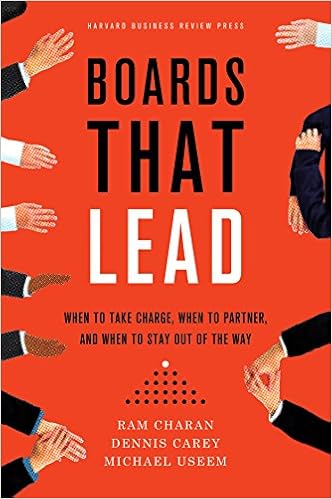
Boards That Lead: When to Take Charge, When to Partner, and When to Stay Out of the Way, by Ram Charan

Free PDF Boards That Lead: When to Take Charge, When to Partner, and When to Stay Out of the Way, by Ram Charan
Boards That Lead: When To Take Charge, When To Partner, And When To Stay Out Of The Way, By Ram Charan. In undertaking this life, numerous individuals constantly aim to do as well as obtain the most effective. New knowledge, encounter, session, as well as everything that can boost the life will be done. Nonetheless, several individuals in some cases feel puzzled to obtain those things. Really feeling the restricted of experience as well as resources to be much better is one of the lacks to have. However, there is a quite basic thing that could be done. This is what your instructor constantly manoeuvres you to do this. Yeah, reading is the response. Checking out a publication as this Boards That Lead: When To Take Charge, When To Partner, And When To Stay Out Of The Way, By Ram Charan as well as other referrals could enhance your life top quality. Exactly how can it be?
Exactly how can? Do you believe that you don't need sufficient time to choose shopping book Boards That Lead: When To Take Charge, When To Partner, And When To Stay Out Of The Way, By Ram Charan Don't bother! Simply rest on your seat. Open your kitchen appliance or computer and also be on the internet. You could open or visit the web link download that we provided to obtain this Boards That Lead: When To Take Charge, When To Partner, And When To Stay Out Of The Way, By Ram Charan By by doing this, you can get the on the internet publication Boards That Lead: When To Take Charge, When To Partner, And When To Stay Out Of The Way, By Ram Charan Reviewing the book Boards That Lead: When To Take Charge, When To Partner, And When To Stay Out Of The Way, By Ram Charan by on-line can be really done effortlessly by waiting in your computer system as well as kitchen appliance. So, you could proceed each time you have leisure time.
So, this is just what this publication provides to you. You could take no notice of this info concerning Boards That Lead: When To Take Charge, When To Partner, And When To Stay Out Of The Way, By Ram Charan Neglecting the advantages of this publication will certainly companion you to be sorry for. Yeah, the advantages of reading this book will certainly be exact same with others. Improving the experience, understanding, and also motivations are the common methods of you to check out some publications. But, the in addition, the benefits will certainly be revealed from each book when analysis as well as completing it.
It will have no question when you are going to pick this e-book. This motivating Boards That Lead: When To Take Charge, When To Partner, And When To Stay Out Of The Way, By Ram Charan e-book can be checked out entirely in specific time depending upon exactly how commonly you open and review them. One to keep in mind is that every e-book has their own production to obtain by each reader. So, be the great viewers as well as be a much better person after reading this e-book Boards That Lead: When To Take Charge, When To Partner, And When To Stay Out Of The Way, By Ram Charan
Product details
Hardcover: 304 pages
Publisher: Harvard Business Review Press (December 10, 2013)
Language: English
ISBN-10: 1422144054
ISBN-13: 978-1422144053
Product Dimensions:
6.4 x 1.1 x 9.3 inches
Shipping Weight: 1 pounds (View shipping rates and policies)
Average Customer Review:
4.4 out of 5 stars
33 customer reviews
Amazon Best Sellers Rank:
#210,005 in Books (See Top 100 in Books)
The latest hot-off-the-press governance book warns, “Like neutrinos and Higgs bosons, early signs of faltering chief executives are often hard to detect.â€The co-authors of “Boards That Lead†add, “Most chief executives are constitutionally optimistic, and since by definition their role is to surmount challenges, the tenor they bring into the boardroom is likely to be relentlessly upbeat. Taking executive overassurance into account will aid directors in detecting nascent troubles ahead, but it is only one piece of a very complicated puzzle.â€That’s the first paragraph of Chapter 8, “Spotting, Catching, or Exiting a Falling CEO,†in this excellent book that delivers three big take-aways for board members. They’re summarized in the arresting subtitle: “When to Take Charge, When to Partner, and When to Stay Out of the Way.â€â€œFrom our several decades of witnessing more than fourscore fumbling CEOs,†they write, “we have noted that, in virtually every case, warning signals were noticed early by at least one or two directors but were commonly not shared with directors. We learned of the indications in real time because alarmed board members privately disclosed their rising qualms about the CEO in our work with them.“The concerned directors were nonetheless hesitant—no surprise—to get the ball rolling. After all, they had helped pick the top executive, and they realized that a forced exit could be not only a career-ender for the executive but also a reputation-killer for themselves. Perhaps most inhibiting of all, they knew that the CEO often retained avid defenders among the other directors.â€What should board members do? “…it is useful for directors to keep a weather eye on early signs of executive deficits. Assuming that the company’s central idea has been well formulated in the boardroom [Editor’s Note: You must read more on this—it’s worth the price of the book.], three embryonic indicators, if ignored too long, often mushroom into far more: • lack of strategy • failure to execute, and • wrong people calls.â€Oh, my! Just when you thought you were knowledgeable in governance, along comes a 219-page poke-in-the-ribs, plus an incredible 40-page section with 18 checklists for board members, a bonus chapter on “Trends in Director Monitoring and Leading,†a director evaluation worksheet, and six golden pages on “Division of Responsibilities Between the Board Leader and the CEO.â€Boards That Lead is a timely must-read for directors of both corporate boards and nonprofit boards. In the past six months (including this week) we’ve seen three high profile Christian nonprofit organizations on the Internet front page (and wishing they were not)—all three for different reasons—but the negative news was all prompted by board actions.Board service is not for the weak of heart.If you’re leading a board, on a board, or considering board service, you’ll want to read Chapter 3, “Recruit Directors Who Build Value.†The co-authors, including Ram Charan, author of “Owning Up: The 14 Questions Every Board Member Needs to Ask,†are big on questions. This chapter asks eight mission-critical questions of prospective board members, including: “Will the candidate be ready to stand tall and engage constructively when vital issues are on the line, the stakes and stress are high, and leadership of the company becomes even more essential?†“Root Out Dysfunction†is Chapter 4’s theme. “In our experience, as many as half of Fortune 500 companies have one or two dysfunctional directors.†The authors identify three types: • “Some see themselves as the smartest person in the room. • Others seek recognition. • Others are frustrated would-be CEOs.â€They add, “Whatever their personal motives, they tend to micromanage or take boardroom discussions down dark alleys. We have seen a director interrupt the first five minutes of a CEO’s boardroom presentation and sour the mood of both board and management for the remainder of the day. The result is to impair, even negate, a board’s capacity to lead the firm. As in any group, a dysfunctional member can sabotage the entire team.â€The authors recommend six personal qualities to look for in a board leader (often the board chair in nonprofit circles): 1) Executive experience, 2) Respect and confidence, 3) Collaboration and restraint, 4) Personal bonding, 5) Personal comfort, and 6) Resilience.Again—not for the weak-hearted. Board leaders (or board chairs) “can anticipate at least one major crisis during their tenures.†Under the “personal comfort†commentary, they share this wisdom: “Yet another factor defining the board leader is a sense of comfort in one’s own skin and place in life, with nothing yet to prove or still to achieve, most often the product of a long and successful career as a corporate leader in one’s own right—no coveting of the chief executive’s office, no longing for operational control.â€Learning boards will discover vast insights and practical next steps: • Boards should ask new CEOs to draft a succession plan immediately (and the annual self-assessment should measure progress). • Caution! Leaders can change dramatically when they get the brass ring. • Nothing can make up for the wrong choice of CEO. • Ten principles for finding the right CEO (Warning: “Review outside consultants carefully to prevent conflicts of interest.â€) • In risk management, why quantification alone is a false crutch. • The value of a one-pager with agenda/decision highlights sent before every meeting • The learned art of what to feed to the board • How to coach new board members to stay at the right “altitude†in board meetings • How to get maximum value from an advisory council or board (They quote Roger Kenny who says advisory boards are “like the Marines: They get you on the beach.â€)And then this PowerPoint-worthy wisdom:“Execution is where management startsand the board stops.â€Oh, my. There is so much more I’d like to add—but I must stop. This is a 2014 Book-of-the-Year contender on my list, and it’s only March. Enjoy!
An important contribution to how boards should function. Most boards don't see themselves as organizational leaders. They see themselves as monitors and guardians, except when they have to change the CEO. This book contributes to breaking that mindset. Boards lead certain functions, partner on others, and need to stay out of the "no-fly zones" reserved for management. But where, when, and how? Rich with many examples, stories, and detailed checklists, "Boards That Lead" provides the answers.The book is light on the multi-stakerholder model, the importance of culture including ethics and integrity, and how to break the cycles of short-termism and excessive CEO compensation, otherwise I would have rated it higher. Worth your time if you are serious about creating more effective boards.
As someone who does consulting on effective Board of Directors, I found this to be a very helpful book. I read a ton of books on this subject, and have also read many (if not all) of Ram Charan's books and I found this to be among the best. Clearly written, excellent information and ideas, things that I found useful and applicable – which you don't always find in every business book. If you work with a Board of Directors – or serve on one – this is a book you should read.
I highly recommend this book not only for board members and prospective board members but also for senior corporate executives and potential investors. The case studies (entertaining and often based on the authors' first hand experiences) provide valuable insights on topics such as "spotting, catching, or exiting a failing CEO", "recruiting directors who build value" and "staying out of the way". The authors' argue that today's boards have an increasingly important role as part of the leadership team in partnership with management in addition to their traditional governance role. But this book is far more than a set of best practices for the boards of America's largest companies. The authors' also provide an invaluable set of Director's Checklists (such as checklist 1: "Board Leadership Decisions - when to take charge, when to partner and when to stay out of the way", and checklist #10: "Is The Board Ready To Lead, Not Just Monitor, The Company". These checklists are thought provoking and invaluable.
Being on 4 company boards, I can relate to many of the issues and opportunities outlined in the book. The principles and practices presented both make the work of being a director more interesting and fulfilling, and give shareholders a way better " bang for the buck" from the board. It also reduces the naturally imperial tendencies of many CEO's, surrounded by their acolytes, and well paid advisors.
Well written in a typical Ram Charan style. I enjoyed reading it, and picked critical lessons as a board member. The insights on the latest challenges and skills sets for boards was helpful. This book reassures board about their fundamental mandate to lead. I have read many books of Ram, this is one of his good ones.
Nice work and real board experience that you can feel they are part of that understanding, and had a clear vision of whats coming next.
Challenges the paradigm of oversight; sets forth basis of board shared responsibility with CEO to provide leadership to meet the challenges of tomorrow; and the requirement of the board to assure executive succession and success - mentoring to success or replacing if stumbling.
Boards That Lead: When to Take Charge, When to Partner, and When to Stay Out of the Way, by Ram Charan PDF
Boards That Lead: When to Take Charge, When to Partner, and When to Stay Out of the Way, by Ram Charan EPub
Boards That Lead: When to Take Charge, When to Partner, and When to Stay Out of the Way, by Ram Charan Doc
Boards That Lead: When to Take Charge, When to Partner, and When to Stay Out of the Way, by Ram Charan iBooks
Boards That Lead: When to Take Charge, When to Partner, and When to Stay Out of the Way, by Ram Charan rtf
Boards That Lead: When to Take Charge, When to Partner, and When to Stay Out of the Way, by Ram Charan Mobipocket
Boards That Lead: When to Take Charge, When to Partner, and When to Stay Out of the Way, by Ram Charan Kindle